"The recipient of a special Academy Award for her performance in Bright Eyes, Shirley Temple became a unique symbol of American movies and a joyous tonic for a nation greatly troubled by the Great Depression. She was a household name throughout the nation and the world.
Instead, she dedicated her life to public service. As a child she was the world's best know ambassador of goodwill. This new chapter in Shirley Temple Black's career was a natural.
She has served our country under four presidents: Richard Nixon appointed her United States Representative to the United Nations in 1969, for Gerald Ford she was Ambassador to the Republic of Ghana and later the first woman White House Chief of Protocol, for Ronald Reagan she served as a foreign affairs officer with the State Department, and George Bush appointed her Ambassador to Czechoslovakia.
For most of the 20th century, Shirley Temple has been this country's little princess, as she continues to captivate and conquer generation after generation whenever her films are shown on television or videotape. As a child, Shirley Temple has given us immeasurable joy and hope, embodying the American spirit through song and dance. As an adult, Shirley Temple Black continues to open her heart and make a difference in the lives of all who know her. The country, indeed the world, owes a great deal to Shirley Temple."
(http://www.kennedy-center.org/explorer/artists/?entity_id=3814&source_type=A)
Showing posts with label History Biography. Show all posts
Showing posts with label History Biography. Show all posts
Thursday, May 5, 2011

Wednesday, May 4, 2011
Robert Schumacher Resources: Mark
http://vietnam-wall.myarmedforces.com/profile/46760/Robert_Schumacher
Henry Ford Resources: Jarrett
http://www.radford.edu/~wkovarik/papers/fuel.html
http://www.thehenryford.org/exhibits/hf/default.asp
"A historian has said that Henry Ford freed common people from the limitations of their geography. The automobile created mobility on a scale never known before, and the total effect on living habits and social customs is endless. In the days of horse-drawn transportation, the practical limit of wagon travel was 10 to 15 miles, so that meant any community or individual farm more than 15 miles from a city, a railroad, or a navigable waterway was isolated from the mainstream of economic and social life. Motor vehicles and paved roads have narrowed the gap between rural and urban life. Farmers can ship easily and economically by truck and can drive to town when it is convenient. In addition, such institutions as regional schools and hospitals are now accessible by bus and car.
steadily reduced the cost of the Model T. Instead of pocketing the profits; Ford lowered the price of his car. As a result, Ford Motors sold more cars and steadily increased its earnings - transforming the automobile from a luxury toy to a mainstay of American society.
Central to Ford's ability to produce an affordable car was the development of the assembly line that increased the efficiency of manufacture and decreased its cost. Ford did not conceive the concept, he perfected it. Prior to the introduction of the assembly line, cars were individually crafted by teams of skilled workmen - a slow and expensive procedure. The assembly line reversed the process of automobile manufacture. Instead of workers going to the car, the car came to the worker who performed the same task of assembly over and over again. With the introduction and perfection of the process, Ford was able to reduce the assembly time of a Model T from twelve and a half hours to less than six hours. "
(http://www.eyewitnesstohistory.com/ford.htm)
http://www.thehenryford.org/exhibits/hf/default.asp
"A historian has said that Henry Ford freed common people from the limitations of their geography. The automobile created mobility on a scale never known before, and the total effect on living habits and social customs is endless. In the days of horse-drawn transportation, the practical limit of wagon travel was 10 to 15 miles, so that meant any community or individual farm more than 15 miles from a city, a railroad, or a navigable waterway was isolated from the mainstream of economic and social life. Motor vehicles and paved roads have narrowed the gap between rural and urban life. Farmers can ship easily and economically by truck and can drive to town when it is convenient. In addition, such institutions as regional schools and hospitals are now accessible by bus and car.
Yet, the effect on city life has been, if anything, more prominent than the effect on the farms. The automobile has radically changed city life by accelerating the outward expansion of population into the suburbs. The suburban trend is emphasized by the fact that highway transportation encourages business and industry to move outward to sites where land is cheaper, where access by car and truck is easier than in crowded cities, and where space is available for their one or two story structures. Better roads were constructed, which further increased travel throughout the nation. As with other automobile-related phenomena, the trend is most noticeable in the United States but is rapidly appearing elsewhere in the world.
Before the automobile, people both lived in the city and worked in the city, or lived in the country and worked on a farm. Because of the automobile, the growth of suburbs has allowed people to live on the outskirts of the city and be able to work in the city by commuting. New jobs due to the impact of the automobile such as fast food, city/highway construction, state patrol/police, convenience stores, gas stations, auto repair shops, auto shops, etc. allow more employment for the world's growing population. "
(http://l3d.cs.colorado.edu/systems/agentsheets/New-Vista/automobile/)
"Henry Ford did not invent the car; he produced an automobile that was within the economic reach of the average American. While other manufacturers were content to target a market of the well-to-do, Ford developed a design and a method of manufacture that
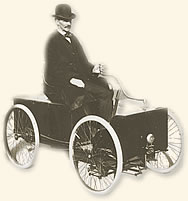 Henry Ford and his first car the Quadricycle, which he built in 1896 |
Central to Ford's ability to produce an affordable car was the development of the assembly line that increased the efficiency of manufacture and decreased its cost. Ford did not conceive the concept, he perfected it. Prior to the introduction of the assembly line, cars were individually crafted by teams of skilled workmen - a slow and expensive procedure. The assembly line reversed the process of automobile manufacture. Instead of workers going to the car, the car came to the worker who performed the same task of assembly over and over again. With the introduction and perfection of the process, Ford was able to reduce the assembly time of a Model T from twelve and a half hours to less than six hours. "
(http://www.eyewitnesstohistory.com/ford.htm)
Elvis Resources: Denisse and Cameron
http://www.america.gov/st/washfile-english/2006/July/20060710113924aawajuk4.964846e-02.html
http://www.imdb.com/name/nm0000062/
http://www.gwu.edu/~nsarchiv/nsa/elvis/elnix.html
http://www.imdb.com/name/nm0000062/
http://www.gwu.edu/~nsarchiv/nsa/elvis/elnix.html
Walt Disney Resources: Marissa, Tanner, Noel, Torrie
http://imagineerebirth.blogspot.com/2006/04/walt-disney-talks-his-business.html
http://animatedviews.com/2002/the-dad-behind-the-myth-an-interview-with-walt-disney%E2%80%99s-daughter-diane/
http://blog.readex.com/if-at-first-you-do-not-succeed-walt-disney-introduces-mickey-mouse-may-15-1928
http://www.skylighters.org/disney/
http://thehistoryofdisney.blogspot.com/2010/08/disney-influence-and-1964-1965-worlds.html
http://animatedviews.com/2002/the-dad-behind-the-myth-an-interview-with-walt-disney%E2%80%99s-daughter-diane/
http://blog.readex.com/if-at-first-you-do-not-succeed-walt-disney-introduces-mickey-mouse-may-15-1928
http://www.skylighters.org/disney/
http://thehistoryofdisney.blogspot.com/2010/08/disney-influence-and-1964-1965-worlds.html
Subscribe to:
Posts (Atom)